Written by Dr Rebecca, GMC-registered doctor and founder of The Beauty Doctors, Caterham, Surrey.
TLDR
Real hyperdilute Radiesse results show up gradually, usually somewhere between three and six months, as your own collagen rebuilds. You won’t walk out with a new face. While the gel carrier settles quickly, the collagen work takes months. The manufacturer’s own décolleté examples were photographed six months into treatment, often after more than one session. So judge it on a calendar, not a weekend.
If you’ve been searching for hyperdilute Radiesse before and after photos, I’d guess you’re not after bigger cheeks. You’re probably looking at your neck, your chest, your hands or the skin on your lower face, which has gone a bit thin or crepey, and wondering what “better” would actually look like.
I hear the same thing in clinic in Caterham all the time: “I don’t want to look done. I just want this to look like skin again.” That’s exactly the right way to think about it. So in this post I’ll walk you through what the results look like, when you can expect them, and what this treatment won’t do.

What hyperdilute Radiesse won’t do
It won’t fill you out instantly. Standard Radiesse can add structure, but once it’s diluted (or hyperdiluted), the aim changes completely. We’re working on skin quality, firmness and texture, not a lift you can clock from across the room.
It also won’t freeze your face, give you a new jawline overnight or work miracles in one session. The manufacturer’s patient stories for hyperdiluted décolleté treatment all describe a gradual change. One patient, Maureen, had two sessions six weeks apart, and her photos were taken six months after she started. Another, Lauren, had four sessions six weeks apart, again photographed at six months. You can see them on the RADIESSE before and after page. Bear in mind they’re individual cases, and your plan won’t be identical to theirs.
And if your mid-face has genuinely dropped, this isn’t the fix for that. The order of treatment matters. If you need support putting back first, a light skin treatment on top simply won’t do that job, and I’ll tell you if what you’re asking for doesn’t match what I can see.
The timeline I give my patients
On the day. You might be a little pink or swollen, and some people bruise. That’s from the injections, not the result, so please don’t compare a same-day selfie with a “finished” photo you’ve found online.
The first two weeks. Most of what you see now is the product settling, not new collagen. You’ll find plenty of early photos online of undiluted Radiesse on hands and jawlines, taken at two to four weeks, but that’s a different treatment doing a different job (adding volume and contour). It’s not a fair comparison for a hyperdilute neck or chest.
Around four to eight weeks. This is often when patients tell me their skin feels less papery. They don’t look like someone else, they just notice their skin is behaving better. If your plan includes a second session, it usually falls around here, but that’s based on how your skin is responding rather than a fixed package.
Three to six months. This is the real window for hyperdilute Radiesse before and after photos, because collagen takes time to build. A 2023 study on hyperdiluted Radiesse for the face, neck, décolletage and hands gave patients three sessions a month apart and followed them up over the following months, with assessments as late as a year in. You can read it here: Massidda, Clinical, Cosmetic and Investigational Dermatology, 2023. It’s one clinic’s results, though, so it can’t promise a particular outcome for you.
After six months. Maintenance is different for everyone. Some people benefit from a top-up later on and some don’t. We’ll decide that together in clinic, based on how your skin looks, not on a set schedule.
What a good hyperdilute Radiesse before and after should show
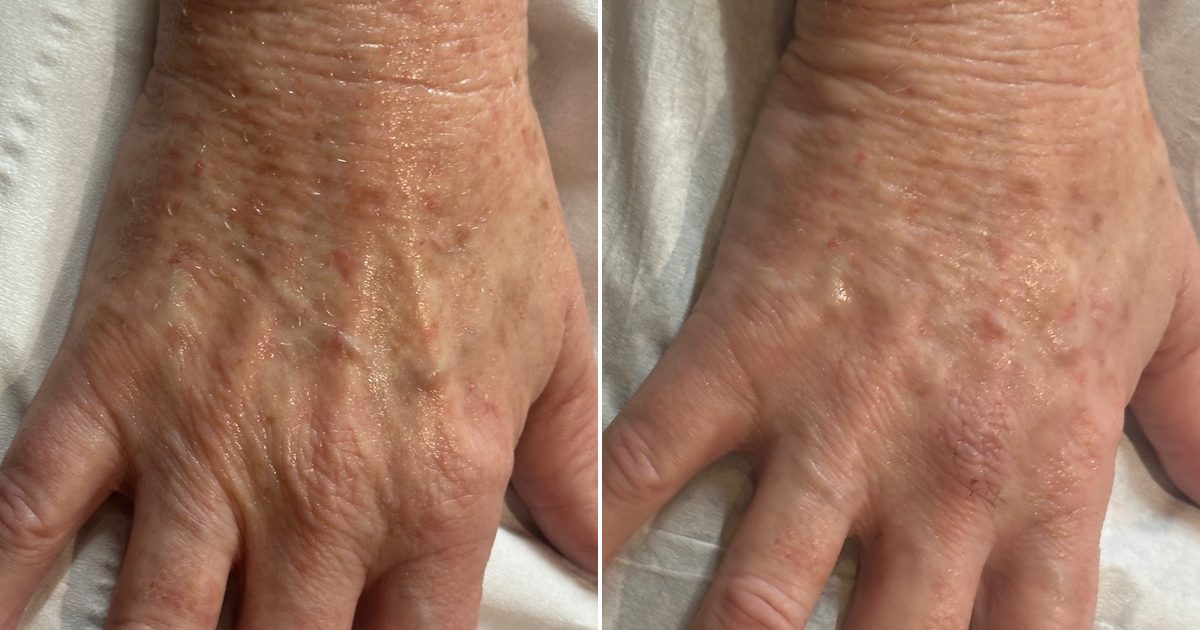
A useful pair of photos is taken in the same light, from the same angle, with the same expression, a few months apart. Necks and chests are very unforgiving in photos, and a phone flash or a tucked chin can make a huge difference either way.
Here’s what I’d want you to look for:
- Skin that looks a little thicker and less crepey (you should still look like you)
- A neck or chest that looks better in everyday light
- Hands that look less thin and bony over the tendons, if that’s what you wanted to improve
- No visible lumps of product
What you shouldn’t expect is a sharp, sculpted jawline from a hyperdilute treatment, or a dramatic change by the weekend. The goal is looking well, not looking different.
Hyperdilute Radiesse often comes up in the same conversation as Profhilo. They’re different products, and sometimes one makes more sense as a starting point. Other times we use both, a few months apart, as part of a wider plan. You can read more about the product on our Radiesse treatment page. And if your jowls are what bother you most, have a look at my guide to non-surgical jowl treatment first.

Who it’s for (and who it isn’t)
It’s a good fit for patients who come to see us from Caterham, Reigate, Oxted and the surrounding Surrey villages whose main concern is skin quality: a crepey neck, a tired-looking chest, thinning hands, or a lower face that looks tired rather than hollow.
It’s not the right choice if you’ve just seen it trending on Instagram, or if you really need volume first but aren’t keen to hear that. It’s also still an injectable medical product. Diluting it doesn’t make it a casual treatment, which is why every injectable at The Beauty Doctors is carried out by a doctor.
As a GMC-registered doctor, my advice is simple: whoever you see should be able to explain why they’ve chosen that dilution and that depth, and what they’d do if a blood vessel were affected. If they can’t, find someone who can.
The common short-term side effects are what you’d expect from any injectable: redness, swelling, bruising and tenderness. Small lumps (nodules) can occasionally form, especially if the product gathers in one place. The manufacturer’s safety information also covers rare but serious complications involving blood vessels when injecting the face, and you can find their patient information on radiesse.com. Please let your doctor know if you take blood thinners, are pregnant or breastfeeding, have an active skin infection, or have any dental work coming up.
Hyperdilute Radiesse: collagen stimulation for the lower face
Hyperdilute Radiesse is a different category from standard filler. Radiesse, used in a diluted form across the lower face, jawline and neck, acts as a biostimulator. It reinvigorates the cells that produce collagen, cells that become lazy and less efficient as we age. The effect builds over several months and does not add immediate bulk. That can improve firmness and texture in areas where traditional filler is not the right tool.
Results are gradual and cumulative, which suits patients who want to look like a better version of themselves rather than someone who has clearly “had something done.”
Want to talk it through?
Book a consultation at our Caterham clinic. We’ll look at your whole face as well as the area that’s bothering you, and work out together whether hyperdilute Radiesse belongs in your plan now, later, or not at all. Book your consultation.
Book A Consultation
About the author
Dr Rebecca is a GMC-registered doctor and member of the Royal College of Physicians, and the founder of The Beauty Doctors in Caterham, Surrey. She treats patients with Morpheus8, dermal fillers, Facial Harmonisation and hyperdilute Radiesse, and is known for an honest, non-cookie-cutter approach to aesthetics.