

Written by Dr Rebecca, GMC-registered doctor and founder of The Beauty Doctors, Caterham, Surrey.
Last updated: November 2026
TLDR
Tear trough filler can soften under-eye hollows and shadows straight away, but swelling and bruising mean the true result usually takes two to four weeks to show, so that’s when a fair before and after photo should be taken. The area often looks worse before it looks better, with mild swelling for a few days and any bruising lasting up to a couple of weeks. It works best when volume loss is causing the shadow. It won’t fix pigmentation or eye bags. So judge your photos once everything has settled, not with a selfie on day two.
If you’ve been searching for tear trough filler before and after or under-eye filler photos, I’d guess you’re looking at hollowness, shadows and that permanently tired look, and wondering what natural-looking eyes would look like on a real face rather than a filtered grid.
That’s something I hear almost every week: “I look exhausted even when I’ve slept. But I don’t want sausages under my eyes.” And it’s exactly the right instinct, because the best tear trough results are the ones nobody can spot.
What tear trough filler won’t do
It won’t fix pigmentation. Tear trough filler only helps with darkness caused by shadows from volume loss. It won’t remove pigmentation, visible blood vessels under thin skin, or dark circles caused by allergies or lifestyle.
It won’t fix large eye bags or fluid retention. If you retain fluid easily, have prominent eye bags or a lot of loose skin under your eyes, filler can actually make the area look puffier. If your anatomy isn’t suited to it, I’ll tell you.
It isn’t the same as Profhilo or polynucleotides. Those treatments improve skin quality, but they can’t rebuild a hollow the way carefully placed hyaluronic acid filler can. And if crepey texture or thin skin is the main problem, adding volume alone won’t solve it. I’ve written more about this in my guide to polynucleotides vs tear trough filler.
It isn’t always the first step, either. Sometimes supporting the mid-face (the cheeks) changes the shadow under the eyes without putting any filler in the tear trough at all. Looking at the whole face works better than chasing one line.
And it won’t give you brand-new eyes overnight. Swelling is part of the process, so a useful tear trough filler before and after needs calm lighting, the same angle and time for everything to settle.
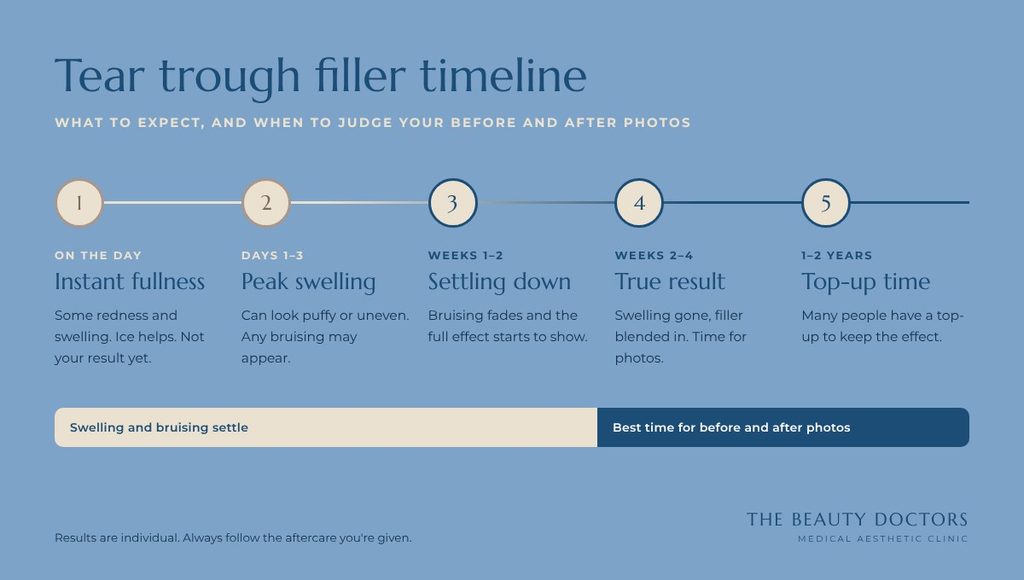
The timeline I give my patients
On the day
The treatment itself is quick, often about five to ten minutes once we’ve assessed you and prepared the skin. Filler is placed in several small amounts along the tear trough, using a very fine needle or a blunt cannula. You may look fuller straight away, but a photo taken now isn’t a fair tear trough filler before and after. You’ll leave with advice on using ice and written aftercare. You can read more in the Cleveland Clinic guide to tear trough filler.
For the first 24 to 48 hours, avoid strenuous exercise, alcohol, saunas and steam rooms, and pressing on the area. Sleeping with your head propped up on an extra pillow can help with swelling, and try not to sleep face down or touch your eyes during this time. Always follow the written aftercare you’re given.
Days 1 to 3
This is usually when swelling is at its worst. One side may look different from the other, and any bruising can appear and then start to fade. The area might look more puffy than hollow for now, so please don’t judge your tear trough filler before and after on day two, especially if you have a big event coming up!
Around one to two weeks
Any bruising may still be fading, as it can last up to a couple of weeks. Early redness and swelling usually settle, and the full effect becomes more noticeable at around two weeks. You’re getting closer to a fair first look, but the delicate skin under the eyes can still hold some fluid.
Two to four weeks
By now the area has usually fully settled, the swelling has gone and the filler has blended in, so you can see the true result. This is the real window for tear trough filler before and after photos. If any small adjustments are needed, they’re best made once everything has settled, not while there’s still swelling. According to Save Face’s guide to tear trough filler safety, this is when the final result is revealed.
The months ahead
How long filler lasts depends on your anatomy and the product used, but many people need a top-up every one to two years to maintain the effect. Your face, the product, the amount used and your lifestyle all make a difference. Maintenance is something we plan together, not something to panic-book after one tired-looking photo.
What a good tear trough filler before and after should show
A useful tear trough filler before and after pair is taken in the same light, from the same angle, with the same expression, at least two weeks apart (longer if things are still settling). A phone flash or a tucked chin can make a huge difference either way, so compare your eyes at rest, from a three-quarter angle, and with a gentle smile if that’s how you usually look in photos.
Here’s what I’d want you to look for:
- Softer hollows and shadows, without a shiny, puffy look or a blue-grey tinge under thin skin
- A smooth transition from the lower eyelid into the upper cheek, with no visible ridge of filler
- You, looking less tired, not like a different person
- A result that’s balanced with the rest of your face, rather than eyes that have been treated in isolation
What you shouldn’t expect is a same-day glow-up, or under-eye filler being used to try to fix pigmentation or bags.
Common short-term side effects include bruising, swelling, tenderness and slight unevenness, which usually settle within a few days to two weeks. Less commonly, there can be longer-lasting swelling, visible filler, uneven texture, infection, filler moving out of place, or swelling that appears weeks or months later, which is more common under the eyes. Rarely, filler can block a blood vessel, which is serious. If you notice severe pain, the skin turning white or blotchy, or any changes to your vision, including floaters, contact your practitioner straight away. Hyaluronic acid filler can be dissolved if needed, which is one reason it matters that whoever treats you is properly trained to manage complications.
In the UK, dermal fillers are much less tightly regulated than prescription medicines, so choose someone who assesses you face to face, understands the anatomy under the eyes, can deal with complications and will tell you if you’re not a good candidate. At The Beauty Doctors, every injectable treatment is carried out by a doctor.
Who it’s for (and who it isn’t)
It’s a good fit for patients who come to see us from Caterham, Reigate, Warlingham and the surrounding Surrey villages whose main concern is genuine hollowness and shadowing from volume loss, whose skin and fluid levels can cope with filler, and who want a subtle, natural change after a proper consultation.
It’s not the right choice if you’re hoping filler will get rid of pigmentation, or if you’ve seen it on social media and want it without a proper assessment. We also won’t treat you if you have an active infection in the area, and we’d pause elective injectables during pregnancy. Some medical conditions change the risks too, so please tell your doctor everything that might be relevant, and we’ll decide together.
If skin quality, crepey texture or fine lines under the eyes are what’s really bothering you, we may suggest polynucleotides, Profhilo, SkinPen or other skin treatments instead of, or before, tear trough filler. And if a drop in the mid-face is causing the shadow, cheek support may come first. You can read more about dermal fillers and Facial Harmonisation, and for skin quality, take a look at Profhilo and polynucleotides.
Want to talk it through?
If you’re comparing tear trough filler before and after photos and wondering whether it’s right for you, book a consultation at our Caterham clinic. We’ll look at your facial structure, your skin, how your under-eyes hold fluid and what bothers you when you look in the mirror, and work out together whether tear trough filler belongs in your plan now, later, or not at all.
Book a consultation at The Beauty Doctors, Caterham
Book A Consultation
About the author
Dr Rebecca is a GMC-registered doctor and member of the Royal College of Physicians, and the founder of The Beauty Doctors in Caterham, Surrey. She treats patients with Morpheus8, dermal fillers, Facial Harmonisation and hyperdilute Radiesse, and is known for an honest, non-cookie-cutter approach to aesthetics.